Sam Goldstein · Oct 1, 2026View on LinkedIn ↗
Case study · Live AI experience · 2026
 Gemini Golf Coach
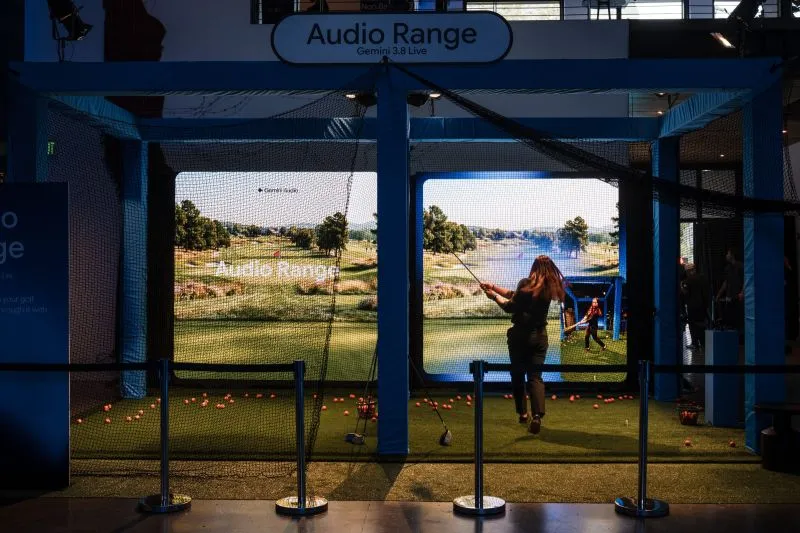
A walk-up AI golf coach for Google’s Gemini audio launch. Cameras measure your swing, Gemini picks the one thing to fix, and a voice coach talks you through it while the replay shows you the moment.
- AI and LLM features
- Voice AI
- Real-time and computer vision
- Live operations
- Client
- Google, Gemini audio launch
- Built with
- Handstand, San Francisco
- Timeline
- 4 weeks · live Sep 24, 2026
- My role
- UI, workflow, coaching, tests
- Stack
- MediaPipe · Gemini 3.8 Live · TS · Python
- Outcome
- 191 guests coached
On this page
191
guests coached
264
swings measured
4 weeks
from first code to event night
9.5 h
live on two bays
See it in action
Every guest left with this.
A personal recap of their swing, rendered in the cloud while they were still at the bay and handed over by QR code. Every joint, angle and graph on screen is measured from the cameras, not generated.
And a Light Loom of their swings.
A neon trace of each swing, built from the guest’s silhouette and the path of the club head. It drew itself on the finale screen and played again in the recap.
Problem
Google wanted its new Gemini audio models shown live at their launch event. Handstand built three walk-up demos, and golf was the hardest. A guest who may never have held a club steps into a netted bay, says their name, swings once, and needs coaching that is actually right. It has to be spoken aloud within seconds, while a queue waits behind them.
Everything was built around one rule. The cameras measure, Gemini interprets. The model never invents a number, a body position or a fault. If it can’t get a clean read, the coach says so.
Constraints
- Four weeks from the first line of code to event night. Hardware arrived mid-build, and the final launch models landed about 48 hours before doors.
- Many guests had never swung a club, so each tip had to be one simple feel they could try on the very next swing.
- The voice model can’t return structured data, so one model decides what to say and another one says it.
- Analysis takes several seconds, and nobody wants to stand there in silence.
What I owned
Handstand built the installation as a team. Hardware, the recap video and the cloud platform were others’ work. I joined the golf build on the first day of code and owned everything the guest sees, hears and steps through.
- The UI. The kiosk screens guests watch, including the replay that jumps to the exact moment the coach is talking about and zooms in on that part of the body.
- The workflow. Every step of a guest’s visit, from saying their name to the second swing and the send-off, and what happens when a swing is missed or unreadable.
- The coaching. What the coach says and how it says it, from the prompts and the rules Gemini works within to the shape of every tip (problem, fix, why it helps, recap).
- The tests. A tuning lab that scored prompts and models against recorded swings, plus the tests that kept the experience working as it changed every day.
- Making it all work. Brought the pieces together and tuned both bays on site through rehearsals and event night, with a recorder capturing every session so nothing went unexplained.
How it works
Two 120 fps cameras → MediaPipe pose → Gemini analysis → Gemini Live voice coach → Replay and recap video
Computer vision does the measuring, with six swing phases and 24 body measurements per swing. Code then works out which faults those measurements actually support, and Gemini chooses from that shortlist. It can’t diagnose anything the cameras didn’t see, and its answer is checked before a word is spoken.
While Gemini thinks, the guest watches their own swing in slow motion from two angles, so the wait becomes part of the show. Then the coach talks them through one fix as the replay walks to each moment. On the second swing, the coach tells them whether it took.
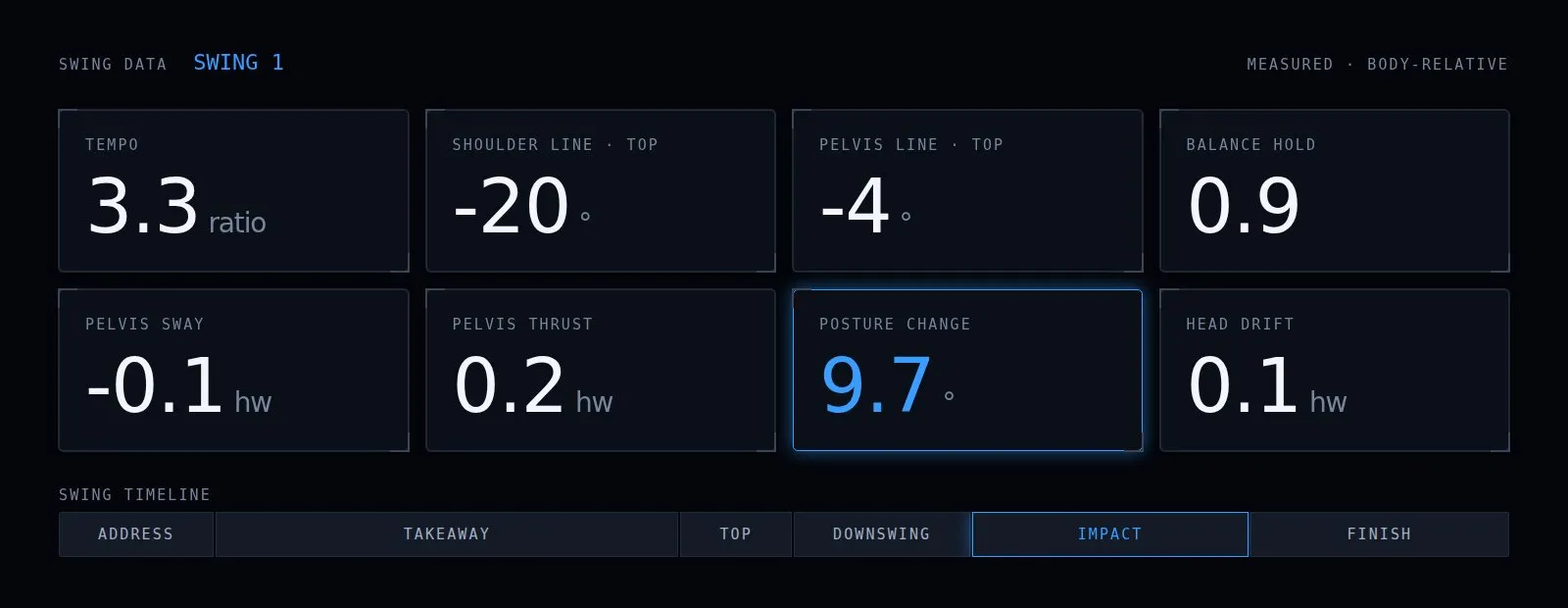
The stats screen shows measured angles only, never a guess.
Results
191 guests were coached across two bays in roughly 9.5 hours. Along the way, a few findings changed what shipped.
| What we found | What changed |
|---|---|
| Left to its own judgement, every model found a fault in every swing, even clean ones. | Gemini now chooses from faults the cameras actually saw. On a clean swing it says so, and on an unclear one it admits it. |
| A teaching pro reviewed the coaching and objected to its favourite tip, “keep your head still”, which opened 42% of its coaching. | Coaching now starts with the foundations (feet, stance, turn) and leaves the head for last. His review became the yardstick every prompt change was scored against. |
| In early tests the voice coach fumbled through 13 tool calls in 17 seconds before saying a word. | I gave the screen a script instead. The coach speaks right away, and the replay follows every word, in sync to the frame. |
| Missed swings left nothing to learn from once the night was over. | A recorder shipped on event night and kept every session, so the team could study what the cameras missed. |
Skills this shows
| If you need | What I did here |
|---|---|
| AI your customers can trust | The coach only talks about what the cameras measured. When it can’t tell, it says so instead of guessing. |
| Proof before launch | I built a tuning lab to test prompts and models on recorded swings, so every change was judged on evidence, not gut feel. |
| An experience people enjoy | The replay walks to the exact moment the coach is describing, so every tip is something you can see. |
| Someone who owns it end to end | I owned the guest experience within Handstand’s build, from UI to coaching to tests, and delivered it for Google’s launch. |
| Calm when it’s live | I tuned both bays on event night and recorded every session so we could learn from it afterwards. |
What this means for your project
- Putting AI in front of your customers? I make sure it only says what it can back up, and test it on real examples before anyone else sees it.
- Is the experience the product? I design for the person using it, with no spinners, no dead air, and every claim something they can see for themselves.
- Small team, big scope? I can own a whole piece of the product, from the AI to the screen it shows up on, and work to your team’s decisions.
At the event
Gemini Audio Live · San Francisco · September 24, 2026
At the Gemini Audio event tonight from @GoogleDeepMind and WOW what a turn out! What an amazing set of launches from that team this week, can't wait to see what folks make with these new models (I've been having a lot of fun myself)!
— Jaclyn Konzelmann (@jacalulu) September 25, 2026
Highlight of the night: Ordering sushi in English to someone who only speaks Japanese and having Gemini Live translate our conversation in real time 🤯 ...then actually getting sushi that was flown in fresh from Japan this morning 🛩️🍣
Jaclyn Konzelmann · Sep 25, 2026View on LinkedIn ↗
Packed house for the @GoogleDeepMind @GoogleAIStudio Audio Event tonight! 🎤 ✨
— Paige Bailey (@DynamicWebPaige) September 25, 2026
Come learn about our new text-to-speech models, which include voice personalization (!!), as well as the updates we've made for live translation, live transcription, and Gemini Live. https://t.co/75aJnmCRtj
The Gemini Audio at Night event was a fantastic wrap to the last few weeks shipping audio models.
— Alisa Fortin (@alisa_fortin) September 25, 2026
So good to meet so many customers and get candid feedback, and catch up with the Gemini Audio teams. The event was stellar: from rooftop DJ to ordering sushi with the help of the Live Translate model to watching the attendees enjoy the demos.
Excited for what we’ve accomplished and so much more to do!
© 2026 Ali Farooq